
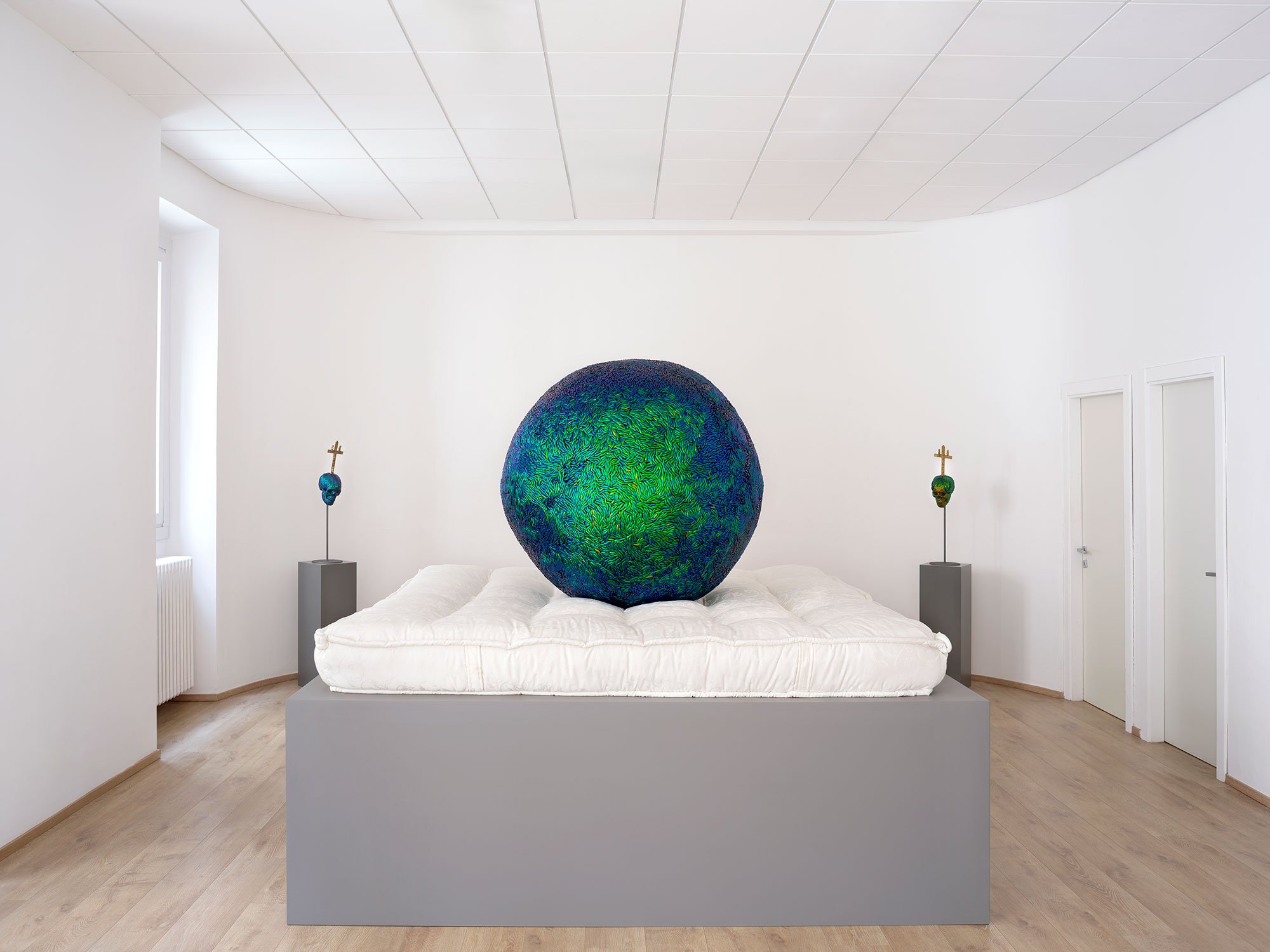
Galleria Gaburro is pleased to announce Jan Fabre’s (Antwerp, 1958) new solo exhibition, Death Keeps Me Awake (La morte mi tiene sveglio), curated by Melania Rossi, which will open on October 7, 2026 from 18.30 in the milanese gallery venue in Via Cerva 25.
The exhibition brings together a special series of works presented together for the first time, including some previously unseen pieces and others historical, created entirely from the elytra of jewel beetles—the organic, iridescent material that constitutes one of the most iconic elements of the Belgian avant-garde genius’s body of work.
Through this technique, which has given rise to some of his most world-renowned installations (such as Heavenly Pleasure (2002), permanently installed inside the Belgian Royal Palace in Brussels), Fabre continues to transform natural material into a surface vibrant with light, where the preciousness of the insect’s exoskeleton becomes a metaphor for the fragility and resilience of human existence.
The works on display create an energetic field in which each piece represents a different intensity of the same life force: the cycle of life, death, and rebirth. The concept of metamorphosis is central to Jan Fabre’s artistic universe, and in this exhibition it is visually linked to both biographical details and spiritual, mythical, historical, and philosophical themes.
The title of the exhibition is taken from a passage in the artist’s Giornali notturni (Night Diaries), published in Italy by Cronopio:
BOGOTÁ, APRIL 6, 2000
Death keeps me awake, alert.
Without death, there is no awareness.
The concept of death has been misused by Western political systems and Western science as something negative, as something violent.
In this reflection, Fabre overturns the Western conception of death as a mere negation of life. Instead, death becomes a generative force—that which keeps consciousness awake, prevents any complacency, and compels human beings to remain on a journey, in continuous research for meaning, beauty, and awareness.
The entire exhibition is permeated by a suspended, sleepless, and silent atmosphere. Insomnia, an experience that has accompanied Fabre since young age, is not merely a biographical condition but takes shape as a privileged mental space for creation. It is the time when rationality does not completely dissolve into sleep and the imagination can generate archetypal images—visions capable of connecting body and spirit, matter and symbol.
The works are set up as elements of a personal cosmology. A cross as the tree of life; skulls that evoke the tradition of vanitas but also become relics of historical memory; a sled-like niche and an urn intended to carry or preserve both matter and spirit; spherical forms that evoke the constant balance between gravity and elevation. Each image reveals the constant tension between opposing forces: permanence and transformation, weight and lightness, finitude and the desire for transcendence.
At the heart of this reflection lies one of the symbolic figures most dear to Fabre: the beetle. Jan Fabre drew inspiration from ancient Flemish paintings, in which the scarab symbolizes rebirth. In the artist’s imagination, it also takes on the significance of a modern incarnation of the myth of Sisyphus, the hero condemned to eternally push his boulder for having defied Thanatos.
Like the dung beetle that drags upward a sphere immensely heavier than its own body, Sisyphus obstinately continues his upward ascent, transforming toil into a gesture of freedom. Albert Camus wrote that “fate belongs to him. The boulder is his,” imagining Sisyphus as happy precisely in his fidelity to his task. Similarly, Fabre’s scarab becomes an image of vital creative perseverance, and its sphere—its weight—is represented in the exhibition in the central work, A Sphere of Sleeplessness.
For Fabre, the image of the globe is also linked to the concept of “problem”—something that stands before us and that we must continually push ahead of us. Here too, the artist draws on an ancient meaning: próblēma derives from the Greek probállō (pro- “before” and bállō “to throw”) and literally refers to a physical obstacle, a barrier, or a boulder along the path.
This tension is inherent in the very nature of the elytra of jewel beetles. Their iridescent surfaces do not produce color through pigments, but refract light, reflecting it in continuous chromatic variations. What was once part of the animal’s protective exoskeleton is transformed in the artist’s hands into a luminous skin, capable of combining strength and vulnerability, splendor and precariousness.
Ancestral creatures, present in the symbolic imagination of numerous civilizations, scarab beetles embody the dialogue between the underworld and the celestial realm, between the earth and the cosmos, between mortality and the idea of immortality. In Jan Fabre’s works, they become a living substance of memory, a surface that holds time.
With Death Keeps Me Awake (La morte mi tiene sveglio), Fabre creates a journey of intense poetic and spiritual power in which death does not signify an end, but rather a threshold of transformation. The works invite us to confront what most intimately defines the human experience: the limit, the desire to transcend it, and the continuous metamorphosis that makes every new form of life and thought possible.
Jan Fabre
Death Keeps me Awake
curated by Melania Rossi
Galleria Gaburro
via Cerva 25, Milano
info@galleriagaburro.com
galleriagaburro.com
(+39) 02 99262529
Opening hours
From Monday to Friday
10.00-13.00 / 14.00-19.00
Free entrance


